
Login or Register for FREE!
Subelement ZLJ

Digital Systems

Section ZLJ30

Digital Systems

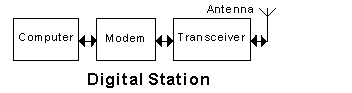
In the block diagram shown, the block designated "modem" is a

  • Correct Answer
    modulator/demodulator
  • modulation emphasis unit
  • Morse demodulator
  • MOSFET de-emphasis unit

Correct answer: A — modulator/demodulator

In a digital station, the modem (a portmanteau of modulator/demodulator) sits between the computer and the transceiver. It converts digital data from the computer into audio tones (modulation) that the transceiver can transmit, and reverses the process on receive — converting incoming audio tones back into digital data the computer can read. Common digital modes using a modem include RTTY, PSK31, and packet radio.

  • B. modulation emphasis unit — Pre-emphasis/de-emphasis circuits are used in FM audio processing, not as the interface between a computer and transceiver.
  • C. Morse demodulator — A modem handles two-way conversion across many digital modes; it is not limited to decoding Morse, and Morse decoders are a separate, specialised function.
  • D. MOSFET de-emphasis unit — MOSFET refers to a type of transistor; this is not a recognised block-diagram function for a digital station interface.

Therefore, the "modem" block in a digital station block diagram is a modulator/demodulator, converting between computer data and audio signals suitable for transmission and reception.

Last edited by jim.carroll. Register to edit

Tags: none

In the block diagram shown, the "modem"

  • monitors the demodulated signals
  • de-emphasises the modulated data
  • Correct Answer
    translates digital signals to and from audio signals
  • determines the modulation protocol

Correct answer: translates digital signals to and from audio signals

A modem (modulator–demodulator) converts:

  • digital data from the computer → into audio tones for transmission
  • received audio tones → back into digital data

This allows digital communication over radio systems that handle audio-frequency signals.

  • It does not simply monitor signals.
  • De-emphasis is an FM audio process.
  • Protocols are determined by software, not the modem itself.

Therefore, the modem translates digital signals to and from audio signals.

Last edited by jim.carroll. Register to edit

Tags: none

The following can be adapted for use as a modem

  • an electronic keyer
  • a spare transceiver
  • a spare receiver
  • Correct Answer
    a computer sound-card

Correct answer: D — a computer sound-card

A computer sound-card can be adapted for use as a modem because it contains the key functional blocks needed for digital data communication over radio: a digital-to-analogue converter (DAC) for transmit audio and an analogue-to-digital converter (ADC) for received audio. Software such as Fldigi or WSJT-X uses these to generate and decode modulated audio tones, effectively performing the modulation/demodulation function of a modem. The sound-card connects between the computer and a transceiver, handling the audio interface while software handles the signal processing.

  • An electronic keyer is a device for generating Morse code dit/dah timing; it has no capability for generating or decoding arbitrary modulated data signals.
  • A spare transceiver handles RF transmission and reception but does not perform the baseband modulation/demodulation (modem) function itself.
  • A spare receiver can only demodulate RF to audio; it lacks a transmit path and the DAC needed for a complete modem function.

Therefore, a computer sound-card is the correct choice because its ADC/DAC hardware, combined with appropriate software, fulfils the modulation and demodulation role of a modem.

Last edited by jim.carroll. Register to edit

Tags: none

The following are three digital communication modes

  • DSBSC, PACTOR, NBFM
  • AGC, FSK, Clover
  • PSK31, AFC, PSSN
  • Correct Answer
    AMTOR, PACTOR, PSK31

Correct answer: D — AMTOR, PACTOR, PSK31

Digital communication modes encode information as discrete symbols or binary data rather than as a continuously varying analogue signal. AMTOR (Amateur Teleprinting Over Radio), PACTOR, and PSK31 are all well-established amateur digital modes:

  • AMTOR – an error-correcting teleprinter mode derived from SITOR, using FSK at a fixed rate.

  • PACTOR – a more advanced mode combining AMTOR and packet radio techniques, with automatic speed and modulation adaptation.

  • PSK31 – a narrow-bandwidth phase-shift keying mode optimised for keyboard-to-keyboard text communication.

  • Option A is incorrect: DSBSC (Double-Sideband Suppressed Carrier) and NBFM (Narrow-Band FM) are analogue modulation methods, not digital modes.

  • Option B is incorrect: AGC (Automatic Gain Control) and AFC (Automatic Frequency Control) are receiver circuit functions, not communication modes. FSK is a modulation technique rather than a complete digital mode protocol.

  • Option C is incorrect: AFC is a receiver control circuit, and PSSN is not a recognised amateur digital mode. PSK31 is correct, but the other two entries disqualify this option.

Therefore, AMTOR, PACTOR, and PSK31 are all recognised amateur radio digital communication modes, making D the only fully correct answer.

Last edited by jim.carroll. Register to edit

Tags: none

In digital communications, FSK stands for

  • phase selection keying
  • final section keying
  • Correct Answer
    frequency shift keying
  • final signal keying

Correct answer: C — frequency shift keying

FSK (Frequency Shift Keying) is a digital modulation method where binary data is represented by shifting the carrier between two (or more) discrete frequencies. A logic "1" might be transmitted at one frequency and a logic "0" at a slightly different frequency. The receiver distinguishes between the two tones to recover the original data. FSK is widely used in amateur radio digital modes such as RTTY (Radio Teletype).

  • A — phase selection keying: Incorrect. Changing phase to represent data is called Phase Shift Keying (PSK), not FSK.
  • B — final section keying: Incorrect. This is not a recognised term in digital communications.
  • D — final signal keying: Incorrect. This is also not a recognised term; it is a meaningless distractor.

Therefore, FSK stands for frequency shift keying, a modulation technique that encodes digital data as discrete shifts in carrier frequency.

Last edited by jim.carroll. Register to edit

Tags: none

In digital communications, BPSK stands for

  • Correct Answer
    binary phase shift keying
  • baseband polarity shift keying
  • band pass selective keying
  • burst pulse signal keying

Correct answer: binary phase shift keying

BPSK is a digital modulation method in which the phase of a carrier signal is shifted between two discrete values to represent binary data (0 or 1).

  • Baseband polarity shift keying is not a standard term.
  • Band pass selective keying is not a recognised modulation scheme.
  • Burst pulse signal keying is unrelated to phase modulation.

Therefore, BPSK stands for binary phase shift keying.

Last edited by jim.carroll. Register to edit

Tags: none

When your HF digital transmission is received with errors due to multi-path conditions, you should

  • increase transmitter power
  • Correct Answer
    reduce transmitted baud rate
  • reduce transmitter power
  • change frequency slightly

For the receiving end to be able to accurately decode the characters sent, the bits must be sent at a constant speed. The signalling speed of serial data transmissions on wires is measured in bits per second (bps), since the bits are always sent one at a time. However, the signalling speed on a radio link is not measured in bits, but in symbols per second (the unit of symbols/sec is the baud). The symbol is the basic modulated signalling entity on a radio link, and represents the state of each signalling interval. Each symbol may carry one or more (or even less) data bits, depending on the modulation technique. For RTTY, each symbol (a short duration of one tone or another) carries one data bit, so the speed in bps is the same as the baud rate.

Last edited by cmscouler. Register to edit

Tags: none

The letters BBS stand for

  • binary baud system
  • Correct Answer
    bulletin board system
  • basic binary selector
  • broadcast band stopper

Correct answer: B — bulletin board system

A BBS (Bulletin Board System) is a computer-based messaging and file-sharing system that users can connect to in order to read and post messages, download files, and exchange information. In amateur radio, packet radio BBSs allow operators to store and forward messages over radio links, functioning much like an early form of email and community notice board accessible via RF.

  • A — binary baud system: Not a recognised term; "baud" is a unit of symbol rate and has no standard association with the abbreviation BBS.
  • C — basic binary selector: A fabricated term with no meaning in radio or computing.
  • D — broadcast band stopper: While a broadcast band stopper is a real filter device used to reject interference, its abbreviation is not BBS.

Therefore, BBS stands for bulletin board system, a store-and-forward messaging system widely used in amateur packet radio networks.

Last edited by jim.carroll. Register to edit

Tags: none

APRS is an adaptation of packet radio. APRS stands for

  • Correct Answer
    Automatic Packet Reporting System
  • Amateur Position Reporting System
  • Automatic Packet Relay System
  • Amateur Position Relay System

Correct answer: Automatic Packet Reporting System

APRS is a digital communications system used in amateur radio for transmitting real-time data such as position, messages, telemetry, and weather information.

It uses packet radio techniques to automatically report this information over the air.

  • Amateur Position Reporting System is a common misconception.
  • Automatic Packet Relay System is incorrect wording.
  • Amateur Position Relay System is also incorrect.

Therefore, APRS stands for Automatic Packet Reporting System.

Last edited by jim.carroll. Register to edit

Tags: none

The following communication mode is generally used for connecting to a VHF packet radio bulletin board

  • SSB
  • AM
  • Correct Answer
    FM
  • DSB

Correct answer: FM

VHF packet radio bulletin board systems (BBS) typically use frequency modulation (FM) as the underlying transmission mode.

Digital packet data is used to modulate an audio tone, which is then transmitted over an FM carrier.

  • SSB is commonly used on HF for voice and some digital modes.
  • AM is not normally used for packet radio.
  • DSB is not typically used for VHF packet communications.

Therefore, FM is generally used for connecting to a VHF packet radio bulletin board.

Last edited by jim.carroll. Register to edit

Tags: none

Go to ZLH28