An Amateur Radio Station

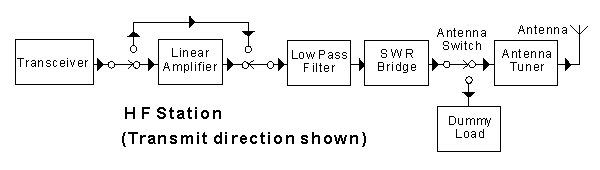
In the block diagram shown, the "linear amplifier" is
-
an amplifier to remove distortion in signals from the transceiver
-
Correct Answeran optional amplifier to be switched in when higher power is required
-
an amplifier with all components arranged in-line
-
a push-pull amplifier to cancel second harmonic distortion
The Linear Amplifier - This is switched in to provide a stronger transmitted signal at times of difficult conditions. Not an essential item and not all radio amateurs use them or find them to be necessary. It provides an amplified version of the signal fed into its input. The term "linear" means that the output signal is a replica of the waveform of the signal fed into its input - except that the amplitude of it is greater.
Last edited by cmscouler. Register to edit
In the block diagram shown, the additional signal path above the "linear amplifier" block indicates that
-
some power is passed around the linear amplifier for stability
-
"feed-forward" correction is being used to increase linearity
-
the linear amplifier input and output terminals may be short-circuited
-
Correct Answerthe linear amplifier may be optionally switched out of circuit to reduce output power
Correct answer: the linear amplifier may be optionally switched out of circuit to reduce output power
The additional signal path above the linear amplifier provides a bypass route around the amplifier stage.
This allows the operator to:
- route the signal directly from the transceiver to the rest of the transmission chain
- operate without using the linear amplifier
This is commonly done to reduce output power when high power is not required.
- It is not used to pass power around the amplifier for stability.
- Feed-forward correction would require a more complex arrangement.
- The input and output terminals are not short-circuited.
Therefore, the additional signal path indicates the linear amplifier may be optionally switched out of circuit to reduce output power.
Last edited by jim.carroll. Register to edit
In the block diagram shown, the "low pass filter" must be rated to
-
Correct Answercarry the full power output from the station
-
filter out higher-frequency modulation components for maximum intelligibility
-
filter out high-amplitude sideband components
-
emphasise low-speed Morse code output
Correct answer: carry the full power output from the station
In the transmit chain shown, the low pass filter is placed after the linear amplifier and before the SWR bridge and antenna system. At this point in the signal path, the RF signal is already at full transmitter power.
The purpose of this low pass filter is to suppress unwanted high-frequency harmonics generated by the power amplifier so they are not radiated by the antenna. Because the filter is carrying the final RF output, it must be rated to safely handle the maximum transmit power and current of the station without overheating or failure.
- filter out higher-frequency modulation components for maximum intelligibility applies to audio filtering, not RF output filtering.
- filter out high-amplitude sideband components is not the function of a low pass filter in the RF output stage.
- emphasise low-speed Morse code output is unrelated to RF filtering and is handled in signal generation or shaping stages.
Therefore, the low pass filter must be rated to carry the full power output from the station.
Last edited by jim.carroll. Register to edit
In the block diagram shown, the "SWR bridge" is a
-
switched wave rectifier for monitoring power output
-
static wave reducer to minimize static electricity from the antenna
-
Correct Answerdevice to monitor the standing-wave-ratio on the antenna feedline
-
short wave rectifier to protect against lightning strikes
Correct answer: C — device to monitor the standing-wave-ratio on the antenna feedline
An SWR (Standing Wave Ratio) bridge is a directional coupler circuit that samples both the forward (transmitted) and reflected power on the feedline between the transmitter and antenna. The ratio of reflected to forward power indicates how well the antenna system is matched to the feedline. A perfect match gives SWR 1:1 (no reflected power); a mismatch causes reflected power that can stress the transmitter and reduce efficiency. In the block diagram, the SWR bridge sits between the Low Pass Filter and the Antenna Switch, allowing the operator to monitor the match and adjust the Antenna Tuner accordingly.
- A — switched wave rectifier for monitoring power output: Incorrect. "SWR" stands for Standing Wave Ratio, not "switched wave rectifier." A wattmeter monitors power output; an SWR bridge monitors impedance match.
- B — static wave reducer to minimise static electricity from the antenna: Incorrect. SWR bridges have no function related to static electricity suppression. Static bleeders or lightning arrestors perform that role.
- D — short wave rectifier to protect against lightning strikes: Incorrect. Lightning protection is provided by surge arrestors or spark gaps, not an SWR bridge. "SWR" does not stand for "short wave rectifier."
Therefore, in any HF station, the SWR bridge is the instrument that monitors standing-wave ratio on the feedline, enabling the operator to optimise the antenna tuner for maximum power transfer.
Last edited by jim.carroll. Register to edit
In the block diagram shown, the "antenna switch"
-
Correct Answerswitches the transmitter output to the dummy load for tune-up purposes
-
switches the antenna from transmit to receive
-
switches the frequency of the antenna for operation on different bands
-
switches surplus output power from the antenna to the dummy load to avoid distortion.
Correct answer: switches the transmitter output to the dummy load for tune-up purposes
In the diagram, the antenna switch allows selection between:
- the antenna (normal operation)
- a dummy load
This is used during tuning or testing to:
-
avoid transmitting a signal over the air
-
safely adjust the transmitter into a known load
-
It is not a transmit/receive (T/R) switch in this context.
-
It does not change antenna frequency.
-
It does not divert “surplus” power.
Therefore, the antenna switch routes the transmitter output to the dummy load for tune-up purposes.
Last edited by jim.carroll. Register to edit
In the block diagram shown, the "antenna tuner"
-
adjusts the resonant frequency of the antenna to minimize harmonic radiation
-
adjusts the resonant frequency of the antenna to maximise power output
-
changes the standing-wave-ratio on the transmission line to the antenna
-
Correct Answeradjusts the impedance of the antenna system seen at the transceiver output
Correct answer: adjusts the impedance of the antenna system seen at the transceiver output
An antenna tuner (or antenna matching unit) does not physically change the antenna itself.
Instead, it provides an impedance match between:
- the transmission line / antenna system, and
- the transceiver output (typically 50 \(\Omega\))
This allows maximum power transfer by presenting a matched load to the transmitter.
- It does not change the antenna’s resonant frequency.
- It does not directly maximise output power.
- It does not change the SWR on the transmission line between the tuner and the antenna.
Therefore, the antenna tuner adjusts the impedance of the antenna system seen at the transceiver output.
Last edited by jim.carroll. Register to edit
In the block diagram shown, the "dummy load" is
-
Correct Answerused to allow adjustment of the transmitter without causing interference to others
-
a load used to absorb surplus power which is rejected by the antenna system
-
used to absorb high-voltage impulses caused by lightning strikes to the antenna
-
an additional load used to compensate for a badly-tuned antenna system
Correct answer: A — used to allow adjustment of the transmitter without causing interference to others
A dummy load is a non-radiating resistive load, matched to the transmitter's output impedance (typically 50 Ω), that absorbs RF power as heat instead of radiating it. In the block diagram, the antenna switch allows the operator to connect the transmitter chain to either the antenna or the dummy load. When testing, tuning, or adjusting the linear amplifier and associated stages, switching to the dummy load means RF energy is dissipated locally rather than being transmitted — avoiding interference to other stations on the frequency.
- B is wrong — the dummy load is not a bypass for surplus or reflected power from the antenna system; that role belongs to the SWR bridge monitoring and the antenna tuner correcting the mismatch.
- C is wrong — lightning protection is handled by surge arrestors or spark gaps, not a dummy load.
- D is wrong — a dummy load is intentionally a well-matched, non-radiating termination, not a compensation device for a poorly tuned antenna.
Therefore, the dummy load's primary purpose is to provide a safe, non-radiating termination so the transmitter can be operated, tested, and adjusted without transmitting a signal that could cause interference to other users.
Last edited by jim.carroll. Register to edit
In the block diagram shown, the connection between the SWR bridge and the antenna switch is normally a
-
twisted pair cable
-
Correct Answercoaxial cable
-
quarter-wave matching section
-
short length of balanced ladder-line
Correct answer: coaxial cable
In typical HF station layouts, the connection between units such as:
- SWR bridge
- antenna switch
- transmitter
is made using coaxial cable.
Coaxial cable provides:
-
proper shielding
-
controlled impedance (typically 50 \(\Omega\))
-
minimal radiation and interference
-
Twisted pair and ladder-line are balanced lines, not typically used between these components.
-
A quarter-wave section is a specific matching device, not a general connection.
Therefore, the connection is normally coaxial cable.
Last edited by jim.carroll. Register to edit
In this block diagram, the block designated "antenna tuner" is not normally necessary when
-
Correct Answerthe antenna input impedance is 50 ohms
-
a half wave antenna is used, fed at one end
-
the antenna is very long compared to a wavelength
-
the antenna is very short compared to a wavelength
Correct answer: the antenna input impedance is 50 ohms
An antenna tuner is used to match the impedance of the antenna system to the transmitter (typically 50 \(\Omega\)).
If the antenna already presents an impedance of:
\[ 50\ \Omega \]
then:
-
the system is already matched
-
no tuner is required
-
maximum power transfer occurs naturally
-
End-fed half-wave antennas usually require matching.
-
Very long or very short antennas typically have mismatched impedances.
Therefore, the tuner is not necessary when the antenna input impedance is 50 ohms.
Last edited by jim.carroll. Register to edit
In the block diagram shown, the connection between the "antenna tuner" and the "antenna" could be made with
-
three-wire mains power cable
-
heavy hook-up wire
-
Correct Answer50 ohm coaxial cable
-
an iron-cored transformer
Correct answer: C — 50 ohm coaxial cable
The connection between an antenna tuner and the antenna in an HF station should be made with a suitable RF transmission line. 50 ohm coaxial cable is the standard impedance-matched feedline used in amateur radio installations — it is designed to carry RF energy efficiently with controlled impedance, low loss, and good shielding against interference.
In the block diagram, the signal path runs: Transceiver → Linear Amplifier → Low Pass Filter → SWR Bridge → Antenna Switch → Antenna Tuner → Antenna. The antenna tuner matches the impedance of the feedline and antenna system, and coaxial cable is the appropriate interconnecting medium at this point in the chain.
- A. Three-wire mains power cable — designed for 50/60 Hz AC power distribution, not RF transmission. It has no controlled impedance and would radiate or absorb RF energy unpredictably.
- B. Heavy hook-up wire — general-purpose DC/low-frequency wiring with no impedance control or shielding; unsuitable for carrying RF signals between station components.
- D. An iron-cored transformer — a component, not a transmission line. Iron cores saturate and are lossy at HF frequencies; this is not a means of connecting an antenna tuner to an antenna.
Therefore, 50 ohm coaxial cable is the correct and standard choice for the feedline connection between the antenna tuner and the antenna in an HF station.
Last edited by jim.carroll. Register to edit